
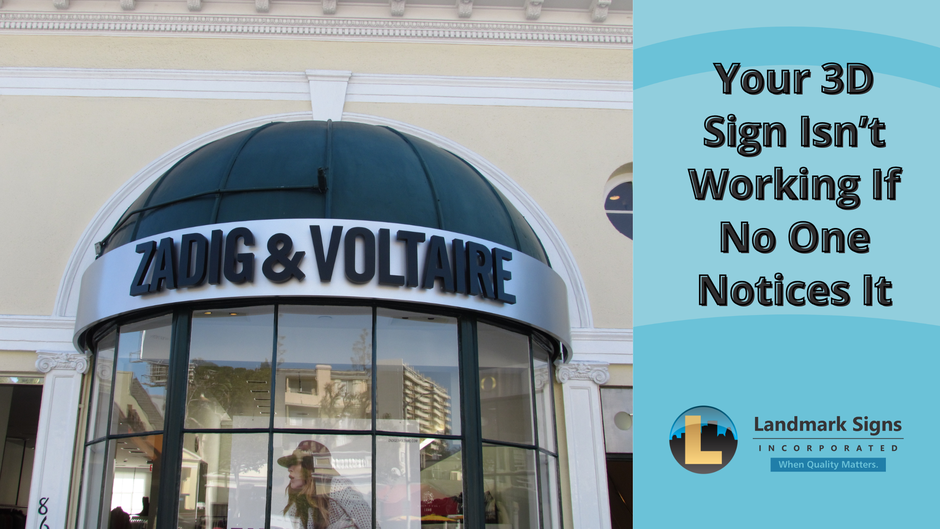
Your 3D Sign Isn’t Working If No One Notices It
There is a very intentional direction many people take when designing a 3D Sign. The goal is not to be loud or overly expressive.
Instead, it is to create something that feels refined, architectural, and sophisticated. Clean lines, minimal visual clutter, controlled proportions, and a restrained overall presence.
And that approach can absolutely work. Subtle, elevated signage can feel more modern and more aligned with high end design language. It can feel intentional in a way that louder signage does not.
But there is a point where subtlety stops being a design choice and becomes a visibility problem.
Because a 3D Sign does not exist in a controlled design environment. It exists in a real world environment where people are moving quickly, attention is divided, and visual competition is constant.
If the sign does not register in that environment, it does not matter how well designed it is. It is not doing its job.
So the real issue is not subtlety. The issue is when a sign becomes so subtle that it is no longer noticed at all.
Why Isn't Your 3D Sign Working?
When a 3D Sign is not being noticed, the instinct is often to assume something is wrong with execution or fabrication. But in many cases, the sign itself is technically well made. The issue is not quality. It is presence.
Modern design sensibilities often prioritize restraint, minimalism, and visual quietness. These can all be strong design principles in the right context. The problem is that signage is not a quiet context.
A 3D Sign is not competing in isolation. It is competing with architecture, environmental textures, lighting changes, movement, reflections, landscaping, and surrounding commercial activity. Every one of those elements is already visually active.
When a sign is designed with too much restraint, it stops standing apart from that environment. It begins to absorb into it. This is where subtlety becomes a risk. Not because subtle design is wrong, but because it reduces the contrast needed for recognition.
Even strong craftsmanship cannot compensate for a lack of visual separation. A sign can be beautifully made and still fail if it does not interrupt the visual field around it.
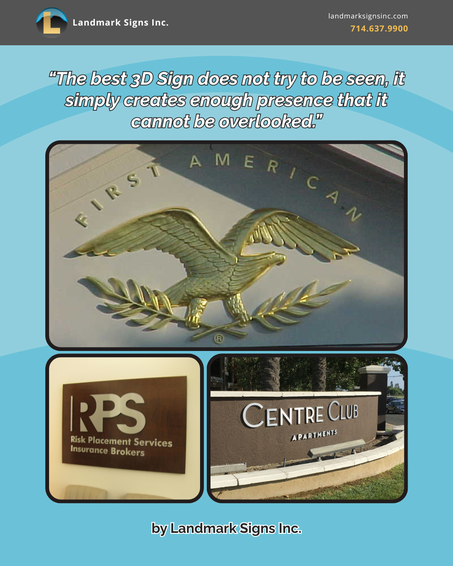
The best 3D Sign does not try to be seen, it simply creates enough presence that it cannot be overlooked. If a sign does not reach that level of presence, it disappears into everything else competing for attention around it, even if the design itself is refined and intentional.

What is a 3D Sign Supposed to do for My Business?
A 3D Sign is often discussed as a branding expression, but its real function is far more direct and practical. It is a visibility tool.
Its purpose is to create immediate recognition in environments where people are not slowing down to evaluate details. It needs to establish presence in a fraction of a second, within a field of competing visual input.
This is where subtle and sophisticated design can still succeed, but only when it is balanced with enough visual strength to remain noticeable.
The goal is not to eliminate refinement. The goal is to ensure refinement does not remove clarity.
A well designed 3D Sign should still feel intentional, architectural, and elevated. But it also needs to stand apart clearly enough that it is not lost in its surroundings.
When a sign becomes too integrated into its environment, it stops functioning as a marker. It becomes decoration instead of communication. And signage that does not communicate in real time is not fulfilling its purpose.
Does a 3D Sign Really Affect the Perception of My Business?
Yes, but the effect is not always conscious or deliberate.
People do not actively analyze signage in most real world situations. They register it or they do not. That split second of recognition is what determines whether a business feels present in a space.
When a 3D Sign is too subtle to be noticed, the business does not necessarily feel negatively perceived. It simply feels absent. It does not register strongly enough to create a lasting impression.
That absence has its own impact. It creates a sense that the business is less defined within its environment, or less visually anchored compared to surrounding locations that are more immediately noticeable.
On the other hand, when a subtle but well balanced sign still achieves visibility, the effect is very different. It feels refined but present. It feels intentional without being loud. It feels established because it is clearly part of the visual landscape.
This is the important distinction. Subtlety is not the issue. Lack of recognition is.
A 3D Sign can be sophisticated and minimal while still being fully effective. But only if it maintains enough presence to be seen in the first place.
What Makes a 3D Sign Actually Get Noticed?
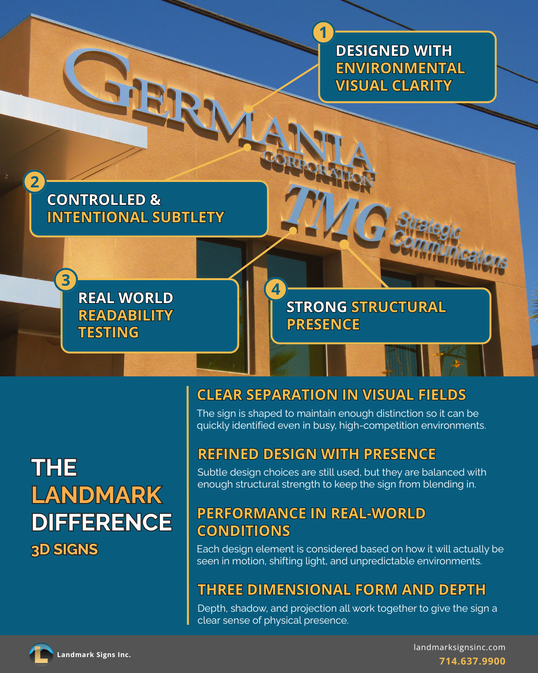
A 3D Sign is not flat communication. It is a physical object that exists within space, and that changes everything about how it is experienced.
Its effectiveness is not based on boldness or complexity, but on whether it has enough dimensional presence to separate itself from the architecture around it. When that presence is reduced too far in the name of subtle design, the sign stops functioning as an object and starts disappearing into the surface behind it.
The goal is not to eliminate sophistication. The goal is to make sure sophistication does not flatten the form.
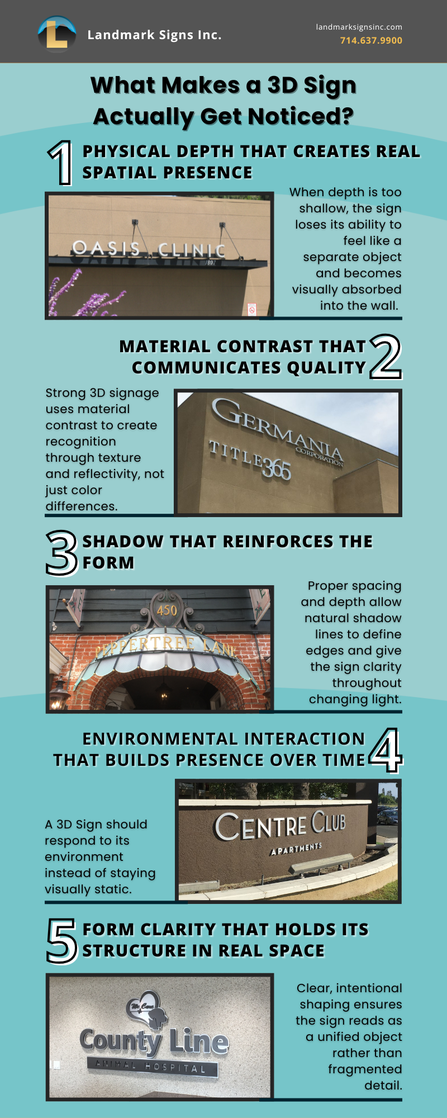
#1 Physical Depth That Creates Real Spatial Presence
Depth is what gives a 3D Sign its identity. When depth is too shallow, the sign loses its ability to feel like a separate object and becomes visually absorbed into the wall. Strong dimensional
spacing allows the sign to project forward, creating separation that can be felt as much as it is seen.
#2 Material Contrast That Communicates Through Surface Quality
3D signage relies heavily on how materials interact with light and surroundings. If materials are too similar to the background surface, the sign loses definition. Strong material contrast allows
the sign to register through texture, reflection, and finish rather than relying only on color.
#3 Shadow That Reinforces the Form
Shadow is not accidental in 3D signage, it is structural. Proper spacing and depth allow natural shadow lines to define edges and give the sign clarity throughout changing light conditions.
Without shadow, the form becomes visually flat and loses its sculptural strength.
#4 Environmental Interaction That Builds Presence Over Time
A 3D Sign should respond to its environment instead of staying visually static. As light shifts throughout the day, the sign should reveal different levels of depth and contrast. When designed
correctly, these changes enhance presence rather than reduce it.
#5 Form Clarity That Holds Its Structure in Real Space
Strong 3D signage depends on clean, readable massing. If forms become overly complex or decorative, the structure breaks down once installed. Clear, intentional shaping ensures the sign reads as
a unified object rather than fragmented detail.
A 3D Sign does not succeed because it is minimal or sophisticated. It succeeds when its physical presence is strong enough to be recognized immediately as an object in space.
When that presence is missing, even the best design becomes visually quiet to the point of disappearing.
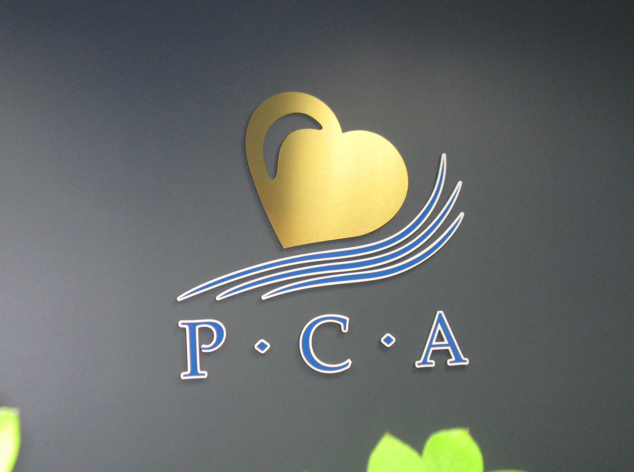
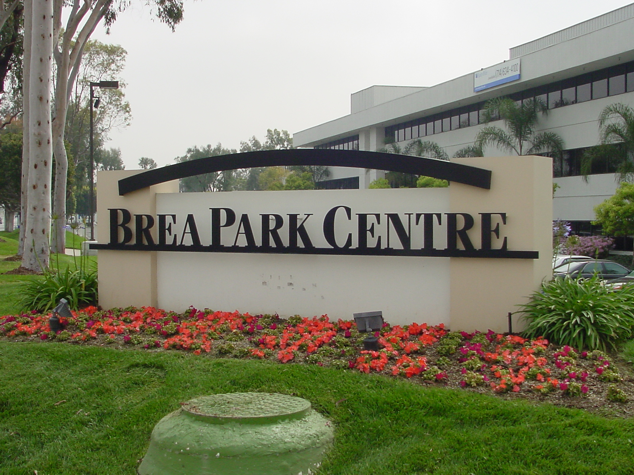
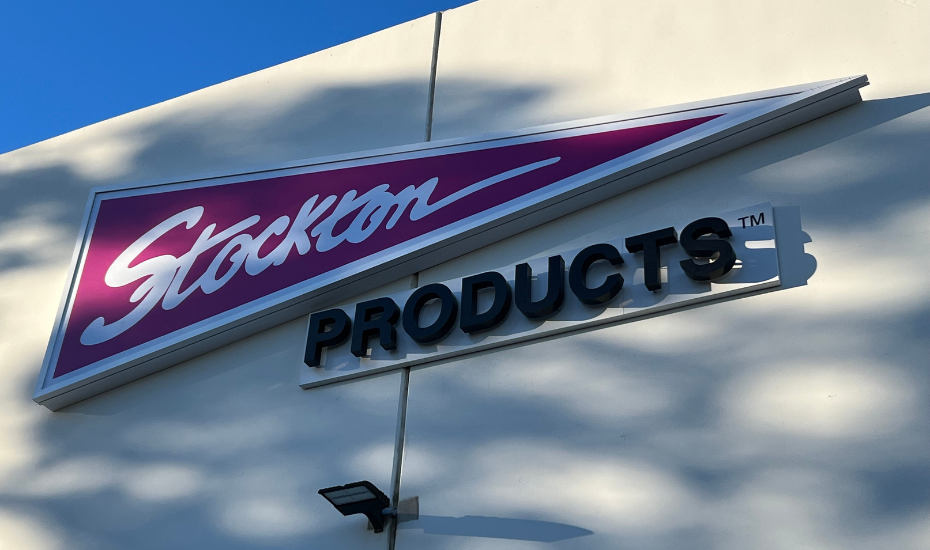
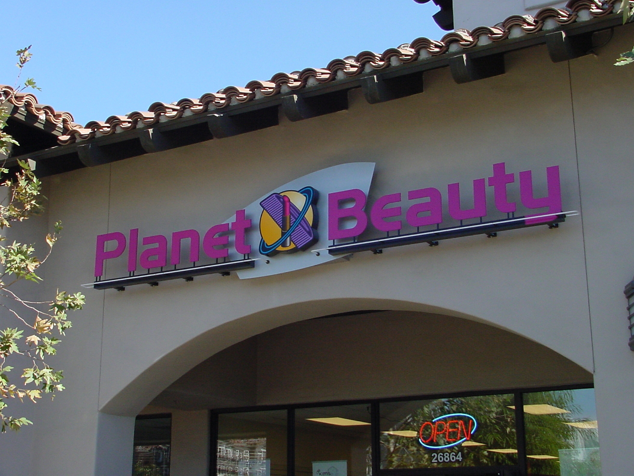
Dimensional Letter Signs by Landmark Signs



An Installed vs a Working 3D Sign

There is a meaningful difference between a 3D Sign that is installed and a sign that actually functions in a real environment.
An installed sign meets all technical expectations. It is fabricated correctly, mounted properly, and visually aligned with the design plan. From a production standpoint, it is complete.
A working sign is defined by something else entirely. It is defined by whether it is noticed.
A working sign creates presence in the environment. It interrupts visual flow just enough to register in the mind of the viewer. It becomes part of how space is understood and navigated.
The difference is not always obvious in design review. It becomes clear only when the sign is placed in its real context, surrounded by competing visual information and constant movement.
This is where many overly subtle designs fail. Not because they are poorly made, but because they do not hold enough presence to function as signage.
What Quality 3D Signs Do Differently

Effective 3D Signs are not defined by whether they are bold or minimal. They are defined by whether they maintain clear visibility while still honoring the design intent behind them.
The strongest designs are not forced to choose between sophistication and performance. They are built to support both at the same time. Subtlety is not the issue in itself. The issue is when subtle design removes the structural clarity needed for the sign to be seen at all.
A well executed 3D Sign can absolutely feel refined, architectural, and understated. But every decision still has to protect one core outcome. The sign has to register in real space, not just look good in concept.
When that balance is handled correctly, subtle design becomes an advantage rather than a risk. It creates a clean, intentional presence that feels elevated without disappearing into the environment.
Overall, a quality 3D Sign can maintain the sophistication so many quality businesses seek, while also making sure to get a business noticed for all the right reasons. If a 3D Sign is so subtle, it does not even get a business noticed, then it is failing to do what signage is supposed to do.
Why do Quality 3D Signs Matter in San Diego?

n San Diego, 3D Signs are not viewed in calm or controlled environments. They exist in highly active visual conditions where architecture, sunlight, traffic flow, and commercial density all compete for attention at the same time.
From coastal business districts to freeway adjacent retail corridors, signage is constantly surrounded by movement and visual variation. Because of that, even well designed signs can easily be overlooked if they do not maintain enough presence in real world conditions.
1. High Visual Competition Across Commercial Areas
San Diego has dense commercial corridors where multiple businesses share the same visual space. From strip centers to business parks, signage is often layered closely together, meaning a sign has to compete directly with neighboring visuals. If it does not create clear separation, it blends into the surrounding field almost instantly.
2. Strong Natural Light That Changes Perception
The intensity of Southern California sunlight can flatten or wash out poorly designed signage throughout the day. What looks clear in controlled conditions can lose definition under bright direct light or sharp shadow transitions. A strong 3D Sign has to maintain clarity even as lighting conditions constantly shift.
3. Constant Movement From Traffic and Pedestrian Flow
Many business locations in San Diego are viewed primarily in motion, whether from freeway traffic, surface streets, or walking foot traffic in retail areas. This means signage is often seen for only a brief moment. If it does not register immediately, it is missed entirely.
4. Architectural Variety That Competes With Signage
Buildings in San Diego range from modern glass storefronts to textured stucco and mixed material facades. This variety creates a visually complex backdrop for signage. A 3D Sign has to separate itself from architectural detail rather than blend into it, which requires intentional control of depth, contrast, and form.
What’s Different About 3D Signs by Landmark Signs Inc?
At Landmark Signs Inc, 3D Signs are built on one principle. If it is not seen, it is not working. That idea shapes every decision in the process. Because in real environments, signage is not experienced in isolation or in controlled design conditions. It is seen in motion, under changing light, and in direct competition with architecture, traffic, and surrounding visual noise.
The focus is never on making signage louder or more visually aggressive just for impact. The goal is to create work that feels refined, intentional, and architectural, while still holding enough structural clarity to be immediately recognized in the real world.
A 3D Sign can absolutely be minimal. It can be elegant, understated, and designed with restraint. In fact, some of the strongest signage relies on that kind of discipline. But restraint has to be supported by visibility. When every element becomes too softened, too reduced, or too closely tied to its background, the sign stops functioning as a distinct object and begins to visually dissolve into the environment around it.
The difference in our approach is that design is always tested against real conditions. Not just how it appears in isolation, but how it performs when it is surrounded by competing stimuli and seen in motion rather than stillness.
When that balance is achieved between refined design and real world clarity, the sign does not need to fight for attention. It simply holds enough presence to be naturally noticed without effort.
FOR YOUR OWN 3D CALL OR TEXT US AT 714.637.9900.
Need One-on-One Personal Help from Start to Finish? Ask about our low-cost and efficient:

If you are an intrepid, passionate and visionary small businessperson, Landmark has a low-cost program for you!
With our exclusive Entrepreneur's Design & Estimate Service, Landmark will:
- Spend unlimited one-on-one time with you, finding out your needs and educating you about signs.
- Survey your location and its sign needs.
- Thoroughly determine any city or county requirements.
- Produce completely custom sign designs, tailored just for you and your brand. You'll be able to change them as much as you'd like.
- Provide you with a very competitive estimate.
Best of all, when you purchase the final product from Landmark, the fee will be rebated, making it essentially free!
Providing Channel Letter Signs in Los Angeles & Beyond
Channel Letter Signs in Orange County

Channel Letters Signs in Los Angeles

Channel Letter Signs in San Diego

Channel Letter Signs in San Francisco

Channel Letter Signs in Santa Barbara

Channel Letter Signs in Lake Tahoe

Channel Letter Signs in Sierra Counties

Write a comment